 Emanuel PescariSign in
Find the Real Cause of Your Pain — Not Just the Symptom
A step-by-step assessment-and-correction method for people who've tried physio, stretching, and rest without lasting results. Chat with an AI trained on the full method, work through 14 modules in six parts, and verify what actually works on your own body.
By Emanuel Pescari · 14 modules · 1 resource
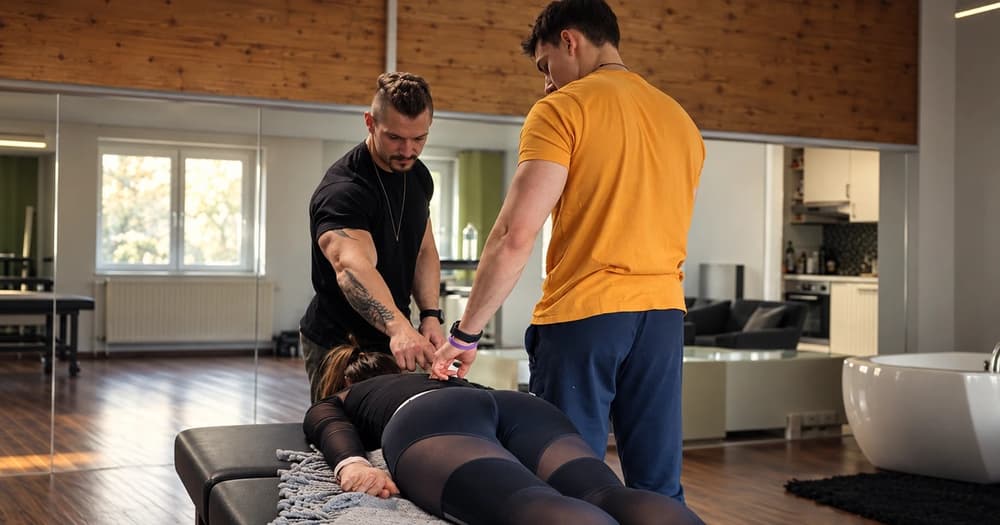
Most corrective-exercise content is a library: drills sorted by joint, memorize and dispense. This is a method instead.
The single idea underneath everything: pain and movement limits usually show up somewhere other than where they're actually caused. A stiff hip is very often not a hip problem — it's a trunk-stability problem the nervous system won't let the hip move past. A sore lower back is very often a stiff mid-back. A knee that hurts is very often a hip or a foot.
What's Inside
14 modules in six parts, built from a full live teaching workshop plus certification-level material on how the body's major structures actually work, from the feet to the jaw:
- Part 1 — The Operating Principles. The four ideas that run through everything else, how the spine, shoulder, and hip are each built and how they influence each other, why concentric, eccentric, and isometric work all matter, and how to use flossing safely, including who should never be flossed.
- Part 2 — Breathing and the Core. The trunk-stabilization system underneath almost every correction: the diaphragm reset step by step, the hiss test, power breathing versus the Valsalva, and what to do with a weak pelvic floor. Plus nerve assist, a gentle stroking sequence that calms a wound-up nervous system.
- Part 3 — How to Assess. Start with the person: the questions that find the real problem before any test, and how to talk about it without arguing or promising. Then the red flags that mean stop and see a doctor, the exact bottom-to-top screening order, the habits that separate a useful assessment from a wasted one, and a real worked example on an actual lifter, including a moment where the first fix chosen wasn't good enough.
- Part 4 — The Lower Body. Foot, ankle, knee, hip, glutes, pelvis, and lower back, with the tests, releases, and loaded corrections for each. Includes how to fix hip pain by stabilizing before you stretch, and why the "blocked SI joint" is very unlikely.
- Part 5 — The Upper Body and Spine. Thoracic spine, shoulder, neck, jaw, elbow, and wrist, plus a real back-pain case: a lower back that kept tightening up because the cause sat one segment higher. Shoulder progressions that get you pressing overhead pain-free again, and tendon loading for tennis and golfer's elbow.
- Part 6 — The Big Lifts as Medicine. How the squat, deadlift, bench, overhead press, and row double as corrective tools, and how to get back to training around a problem: the 4-out-of-10 rule, when to release and when to strengthen, and how to work up to the edge of the pain.
Plus a full Movements & Cues reference — every test and drill from the program, with the exact coaching cues, so you're never guessing what to actually say or do.
How It Works
This isn't a PDF you read once. It's an AI trained on the full method — ask it about your actual shoulder, your actual squat, your actual pain, and it answers from the material, not generic fitness advice. It starts with the right questions before it suggests anything, and it tells you when something needs a doctor. Work through the parts in order, or jump straight to what's bothering you right now.
Who This Is For
Anyone who's tried physio, stretching, or just resting and hasn't gotten lasting results — and coaches who want a real system for finding the cause of a client's problem instead of guessing.
What's inside
1Part 1 — The Operating Principles3 modules
- 1The Operating Principles
- 2The Three Structural Complexes
- 3The Three Contraction Types
2Part 2 — Breathing and the Core2 modules
- 1Breathing and the Core
- 2Calming the Nervous System: Nerve Assist
3Part 3 — How to Assess4 modules
- 1Start With the Person
- 2Red Flags and Safety
- 3How to Assess
- 4Worked Example: A Real Squat Assessment
4Part 4 — The Lower Body1 module
- 1Ankle, Hip, Glutes, Knee, Core and Pelvis
5Part 5 — The Upper Body and Spine2 modules
- 1Thoracic Spine, Shoulder, Neck, Elbow, Wrist and Jaw
- 2Worked Example: Lower Back Pain That Isn't a Lower Back Problem
6Part 6 — The Big Lifts as Medicine2 modules
- 1The Big Lifts as Medicine
- 2Getting Back to Training
Plus 1 file, all inside the product.
This is a course you can talk to.
The lessons are here, and you can read them like any course. But the AI has read all of them too. When something doesn't click, ask. When you're not sure how it applies to you, ask. It answers from Emanuel Pescari's material, not from the internet. It's like hiring Emanuel Pescari as a coach, without paying thousands of dollars for it.
My hip feels tight every time I squat, even after stretching. Where should I actually start?
The Rebuild Protocol
Good question. Here's what Emanuel Pescari teaches about that, and how it fits what you're doing.
This is how learning works now. You don't watch and forget. You ask, you get an answer for your situation, and you use it. That's what makes it stick.
What you can ask
- My hip feels tight every time I squat, even after stretching. Where should I actually start?
- Walk me through the full-body assessment order so I can screen myself properly.
- What's actually causing my shoulder to hurt during bench press?
- I coach clients — how do I use this method's retest habit in a real session?
Use it in your own AI app
Buy once, then open The Rebuild Protocol in the AI app you already use. The instructions and knowledge come with it.
- One click connects it to Claude or Cursor. ChatGPT and Claude Code take a single paste.
- Open a chat and The Rebuild Protocol is already loaded, instructions and knowledge included.
- Using it there costs nothing extra. Your app's own usage still applies.

About Emanuel Pescari
Emanuel Pescari is a four-time Strongman World Champion (U105) and world record holder. He has trained for 20 years and coached for almost 10, and before that he worked 10 years as a registered nurse. He knows pain and injury from the inside, and built the Omnipotens training system around helping people get out of pain and find what they're capable of. Through it, his athletes have become national champions, world champions, and world record holders.
Questions
What is The Rebuild Protocol?
It's a method for finding the real cause of a pain or movement limit, fixing the fewest things possible, and checking within minutes whether the fix worked. You get 14 modules in six parts, a full reference of tests and drills with the exact coaching cues, and an AI trained on the whole method that you can ask about your own body.
Is this a training program?
No. It finds the cause of a problem and gives you the corrections to fix it, and a short guide to getting back to training around it. It doesn't write you a full training week. To keep building, there are three next steps. The Omnipotens premium community has structured programs and live calls where your program gets adapted to you. The Omnipotens Programming Education is a full course on the training system itself, with an AI trained on it. And the Omnipotens Certification, a separate 12-week program that ends in a credential, is coming later.
Does it replace a doctor or physiotherapist?
No. It screens, compares, and suggests. It never diagnoses. There is a full lesson on red flags: sudden severe pain, pain that spreads or shoots, worsening numbness or weakness, and stroke signs all mean stop and see a doctor. Real pain from simple testing, or a hard bony stop at the end of a movement, is a referral, not something to train through.
Who is it for?
People who have a specific pain or movement limit and have tried physio, stretching, or rest without lasting results. It covers what people ask about most: back, knee, and shoulder pain, old injuries, and joints that never quite recovered. It's also for coaches and trainers who want a real system for finding the cause of a client's problem, instead of guessing.
Do I need to be an athlete or know a lot about training?
No. The method works the same for a beginner and a strong lifter, and the lessons show how to scale the load for each. Some drills use heavy weights, and each one comes with an easier version.
What equipment do I need?
Most of it is simple: a resistance band, a lacrosse or massage ball, a broomstick, and a kettlebell or something to hold. Some drills are more effective with a barbell or a rack, and there's a lighter alternative when you don't have one.
How is this different from asking ChatGPT?
A general chatbot answers from everything on the internet, and most of it is generic fitness advice. This AI answers only from the method in the course: it starts with the questions that find the real problem, uses the joint-by-joint map, points you to the specific test with the real cue, and asks you to retest every time. If something isn't covered, it says so instead of making something up.
Can I use it inside Claude, ChatGPT, or another AI app?
Yes. You can connect The Rebuild Protocol to Claude, ChatGPT, and other AI apps through MCP, so you can ask it your questions inside the assistant you already use.
How much can I use the AI?
You get 50 credits. Usually one question costs one credit, and once they're used up, they're used up. After that you can buy extra credits or take a subscription. You can also keep using The Rebuild Protocol through Claude, ChatGPT, or another AI app by connecting it through MCP.
How long does it take to see a result?
The method is built around fast feedback: every corrective drill is followed by a retest, and a drill should show a noticeable, measurable difference within about two minutes. If it doesn't, it's the wrong drill for you and you try another. Lasting change takes repetition. Nobody can promise you a result, and this program doesn't.
Can I use it if I'm in pain right now?
Yes, within limits. The rule for any exercise is that pain stays at 4 out of 10 or below during the exercise, is clearly better an hour later, and is gone or better after 24 hours. Uncomfortable is fine, painful isn't. If it goes past that, you drop back, and if it doesn't settle you see a doctor.
What about injuries, surgery, or medical conditions?
Tell the AI, and check with your doctor first. The safety lesson lists what needs clearance before anything intense: heart conditions, high blood pressure, recent surgery, osteoporosis, and more. Some techniques, like flossing and the diaphragm reset, have their own list of who should not use them.
Do I have to go through everything in order?
No. You can work through the six parts in order, or jump straight to what's bothering you and ask the AI. If you're new, start with the part on assessing, because the way you ask the questions and test is what makes the rest work.
Is it good for coaches and trainers?
Yes. There's a lesson on how to open a session, how to confirm what someone says without arguing, how to coach with one or two cues at a time, and how to record and compare tests so both of you can see the progress.
What happens after I buy?
You get access to all 14 modules, the reference, and the AI right away. There's a Start Here page that shows where to begin and how to keep going: the Omnipotens premium community, the Omnipotens Programming Education, and the Omnipotens Certification (coming later).
What if it doesn't work for me?
There's a full refund within 14 days if it isn't useful to you, no questions asked.
Refunds
Full refund within 14 days if this isn't useful to you — no questions asked.
Emanuel Pescari
This is what helped me rebuild my body multiple times